
The Faroe Islands: The Cruise Stop That Outshone Iceland
As we planned our cruise itinerary, Iceland was supposed to be the highlight. The Faroe Islands cruise stop was just going to be a nice addition. Instead, our Faroe Islands cruise stop turned out to be the best day of the entire trip.
Iceland is known for dramatic nature and adventure around every corner, and it delivers on that. But the Faroe Islands deliver more by delivering less: fewer tourists, smaller crowds, less commercialism, and more room to breathe. To be clear, we’re comparing cruise port days, not two-week vacations. For a single day ashore, the Faroe Islands cruise stop won.

Why the Faroe Islands Deserve Your Port Day
We had never heard of the Faroe Islands until a port day in Runavík was added to our itinerary. It replaced a scheduled stop in the Shetland Islands on our Iceland cruise aboard Holland America. Aside from seeing Faroe Islands salmon on a restaurant menu back home, we had no reference point. (Fun discovery: Bakkafrost, the islands’ biggest salmon producer, is headquartered on the same fjord where our ship docked.)
The Faroe Islands sit in the North Atlantic, roughly halfway between Iceland and Norway and about 200 miles north of Scotland. Tourism here is still young, and that’s exactly why we fell in love with the place. It felt like we were seeing the islands in their raw, unpolished state.
The tourism infrastructure is still developing, but don’t let that discourage you. We saw it as a positive. The Faroese are still figuring out what tourism will look like here, and we’re glad we saw it now. More than once, we’ve described our Faroe Islands cruise stop as what we imagine Iceland was like before its tourism boom, before the hotel construction and the fleets of tour buses arrived.
Arriving at the Runavík Cruise Port
The Faroe Islands put on a show before you ever step off the ship. Sailing into Skálafjørður, you’ll pass rolling green hills and mountains that slope all the way down to the water, with small fishing villages tucked along the shoreline. As you get close to port, you’ll also spot the salmon farming operation that is the area’s biggest industry and employer.
Our ship docked right at the Runavík cruise terminal, so there was no tender boat to worry about at our Faroe Islands cruise stop. Just outside the port is a small parking lot where tour operators meet their guests. If you’d rather explore on your own, know that there isn’t much right at the terminal. Restaurants and shops are a short walk into town.
Faroe Islands cruise passengers looking for a city experience can head to Tórshavn, one of the smallest capital cities in Europe, with about 14,000 residents (around 22,000 in the greater area). It’s roughly a 20-minute drive from the port, and the drive is an adventure of its own. You’ll travel under the ocean from Eysturoy to Streymoy through the Eysturoyartunnilin, an engineering marvel that opened in 2020 and includes the world’s first undersea roundabout. The roundabout sits about 73 meters below the surface of the fjord, wrapped in colorful lighting and artwork by Faroese artist Tróndur Patursson.
Why We Booked a Private Tour on Our Faroe Islands Cruise Stop
We chose to spend a little more so we could see as much of the Faroe Islands as we could pack into one day in port. The Holland America shore excursions each covered one or two sights. That just didn’t feel like enough, given how many natural wonders are spread across the islands.
Seeing the Faroe Islands on our own didn’t seem practical either. Rental cars aren’t easy to get at the cruise terminal, so you’d likely need a cab to and from Tórshavn just to pick one up. And honestly, between the narrow roads, tight turns, and steep mountainside stretches with no guardrails, driving ourselves wasn’t our idea of a stress-free day.
A handful of local companies can build a private Faroe Islands cruise shore excursion around your ship’s schedule. We booked with Faroe Incoming Travel Agency and had a fantastic experience. We worked directly with their general manager, Jógvan, who built a custom day around our budget, the time we had in port, and the sights we most wanted to see.
Our Route Around Eysturoy and Streymoy
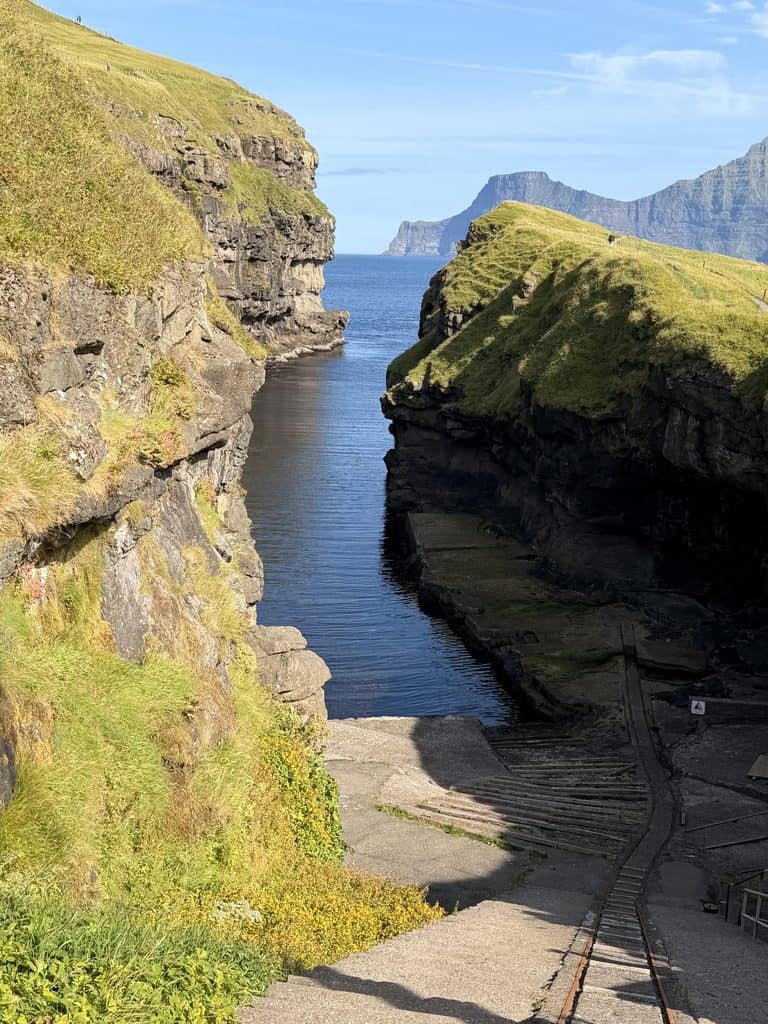
Gjógv Sea Gorge
Gjógv gets its name from the 200-meter, sea-filled gorge that runs from the village straight out to the ocean. It’s one of the best natural harbors in the Faroes, and fishing boats are still hauled up a ramp to keep them out of the swells. Fewer than 20 people live here year-round.
This was the one stop where we competed with a tour bus. It was a James Bond tour; No Time to Die (2021) filmed scenes in the Faroe Islands, and fans now make the pilgrimage. Even so, it never felt overly crowded. It was just busier than anywhere else we went that day.
Practical note: A steep stone staircase leads down to the boat ramp at the head of the gorge. We chose to take in the views from above instead, which still gives you the full sweep of the gorge without the climb back up.
Funningur
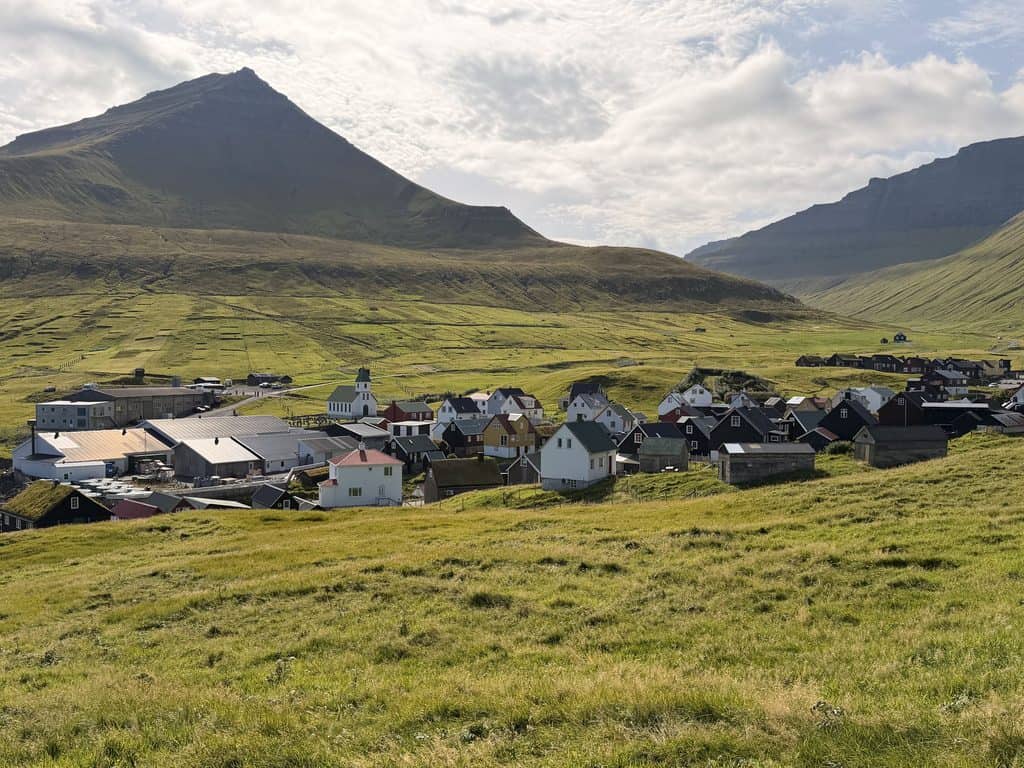
Funningur was a quick stop, but one with a story. Tradition holds that Grímur Kamban, often called the first Viking settler of the Faroe Islands, made his home here, and our guide walked us through the tale of the Vikings’ arrival. The village’s wooden, turf-roofed church, built in 1847 at the water’s edge, makes for a classic Faroese photo.
Risin og Kellingin Sea Stacks
Off the northern tip of Eysturoy near the village of Eiði stand Risin og Kellingin, “The Giant and the Witch.” Risin rises 71 meters and stands farther from shore, while the pointed Kellingin reaches 68 meters. Legend says the pair came from Iceland to drag the Faroes north, worked through the night, and were turned to stone by the rising sun. Geologists expect Kellingin could collapse within the next few decades, so see them while you can.
Sornfelli
Sornfelli wasn’t on our original itinerary. Our driver added it because it’s his favorite spot, and one most visitors don’t know about. The mountain climbs to 749 meters on Streymoy, and a road takes you to the plateau at about 725 meters. It’s often cited as the highest point you can drive to in the Faroe Islands. The summit houses a radar station, a former NATO early-warning site that still supports air traffic control, so the last stretch is closed to visitors. From the top, the view drops straight down into the Mjørkadalur valley.
The weather changed with the altitude. We’d had partly cloudy skies most of the day, but up top it was noticeably colder and fog drifted across the plateau, and our photos show the difference.
Our private tour tip: We always ask our guide, “What’s the one thing you’d show us that isn’t on our itinerary?” That question is how we ended up on Sornfelli, and it’s often how you find the best stop of the day.
Practical note: This stop depends entirely on the weather, since fog can roll in and erase the view in minutes.
Eysturoyartunnilin
We covered the engineering in our arrival section, but nothing prepares you for the roundabout itself. Colored lights and sculpted artwork wrap around the circle, and it feels like seeing the Northern Lights nearly 240 feet under the ocean.
Practical note: We specifically asked for the tunnel to be included in our private tour. It’s a toll tunnel, so it added a little to the price, but it was well worth it. If it’s not on your itinerary, ask for it. Have your camera ready before you enter, because the roundabout comes up quickly.
Tórshavn Harbor
We ended our drive at the waterfront, where the sheer number of boats tied up in the harbor tells you everything about how much the Faroese still live by the sea. The Tinganes peninsula splits the harbor into two halves, Eystaravág and Vestaravág. Its red, turf-roofed buildings date to the 1500s and 1600s and still house the Faroese government. Norse settlers held their assembly here as early as the 9th century, which makes it one of the oldest parliamentary meeting places in the world.
If a port day leaves you wanting more, Tórshavn is the place to base a longer Faroe Islands vacation. Most of the islands’ hotels are here, and new ones keep opening as tourism grows.
Practical note: The harbor and old town are compact and easy to walk. Allow about 45 minutes before heading back to the ship.
Faroe Islands vs. Iceland: How the Cruise Stops Compared
| Faroe Islands (Runavík) | Iceland (Djúpivogur and Reykjavík) | |
|---|---|---|
| Time ashore | About 8 hours | About 8 hours per stop |
| How we explored | Private tour | Ship excursions |
| Headline sights | Gjógv, Risin og Kellingin, Sornfelli, Tórshavn | Jökulsárlón (Glacier Lagoon), Reykjavík |
| Crowds | Low | High |
| Weather | Partly cloudy, colder and foggy on the mountain | Cool but manageable at the Glacier Lagoon |
| Would we do it the same way again? | Yes, but with more time in Tórshavn | Yes. Ship excursions were the most practical way to reach the Glacier Lagoon. |
We visited both in August. Weather is a wild card in both places, and as we saw on Sornfelli, it can change within the day and with altitude. We overpacked for both stops, but we were glad to have layers on the mountain.
Our Faroe Islands cruise gave us raw beauty without the crowds. Compared with Iceland’s polished, commercial tourism, it felt untouched. We’ve taken plenty of tour bus excursions and no doubt will again, but it was refreshing not to see parking lots full of them. The one bus we did encounter looked out of place, crawling through hairpin turns and narrow streets in centuries-old villages. We hope it stays that way, though it probably won’t as more travelers discover these islands.
Iceland gave us the beauty of fire and ice. You can see the results of volcanoes and the timelessness of glaciers, and you won’t find either in the Faroes. Our time at Jökulsárlón, the Glacier Lagoon, was something special. But that appeal brings crowds, along with the commercialism that comes with them.
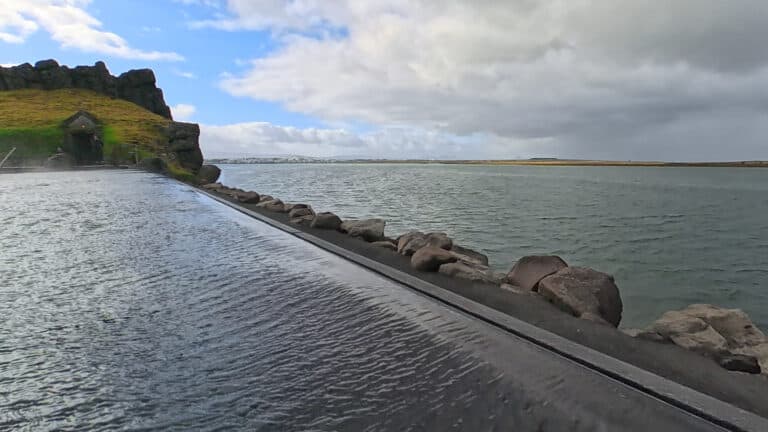
Iceland also has the edge on amenities and attractions if you’d rather not rough it, though you can rough it in either place. You won’t find a Sky Lagoon anywhere in the Faroe Islands. But if you want solitude amid incredible nature, it’s much easier to find in the Faroes.
Frequently Asked Questions
Is a Faroe Islands shore excursion worth it?
Yes. A private tour is the best way to experience the Faroe Islands on a shore excursion. You can customize the itinerary and see more of what the islands have to offer.
Can you explore from Runavík without a tour?
Yes, but you won’t experience what truly makes the Faroe Islands special. Runavík is a port town focused on fishing. There are some shops and restaurants, but not enough to fill a day. Tórshavn, the capital and the largest city in the Faroe Islands, is only about 20 minutes away. Whether by taxi or private car, you’ll want to explore the region beyond the port area you can reach on foot.
How much time do you need?
We did all our exploring in about 6 hours and wish we had allotted more time, especially in the capital.
Is it a good stop for multiple generations traveling together?
Yes, but mobility is something to plan for. Around the port, if you’re walking on your own, there are hills. Some of the paths we ventured onto were grassy and uneven. With the unpolished feel of the Faroe Islands, you’re visiting places that aren’t perfectly accessible.
What to Know Before Your Faroe Islands Cruise Port Day
People have concerns using private companies for shore excursions, and we understand that. Our default first step is to look at what the cruise company offers. In our case in the Faroe Islands, there was plenty of shore time for us to see more than the one or two things a typical cruise excursion offers.
Our Faroe Islands cruise custom tour for three people totaled 4,900 kr, roughly $725 USD for a full day exploring multiple islands. That also included the toll for going on the undersea roundabout.
Language was not a barrier, though our tour guide’s accent did force us to listen very carefully. All of the people we met were very pleasant. Our guide loved talking about American country music, evidently quite popular in the Faroe Islands. He was also incredibly appreciative of our tip at the conclusion of our day with him.