Why a Monasterboice Day Trip Dublin Belongs on Your Ireland Itinerary
Planning a Monasterboice day trip Dublin is one of the best decisions you can make after soaking in the culture of Ireland’s capital. If your schedule only allows a single day, consider a day trip to Belfast that includes a quick stop at one of Ireland’s most remarkable ancient sites. Monasterboice is one of the most important early Christian sites in Ireland, famous for its Celtic high crosses and round tower.
A stop at Monasterboice is little more than a restroom break for Paddywagon Tours in Dublin to Belfast day trip itinerary, but it turned out to be fascinating—especially if you enjoy old cemeteries. And we do love old cemeteries. Located about an hour north of Dublin, we found very little information about the site during our planning, so we’re sharing this to help you prepare for your trip.
Monasterboice Day Trip Dublin
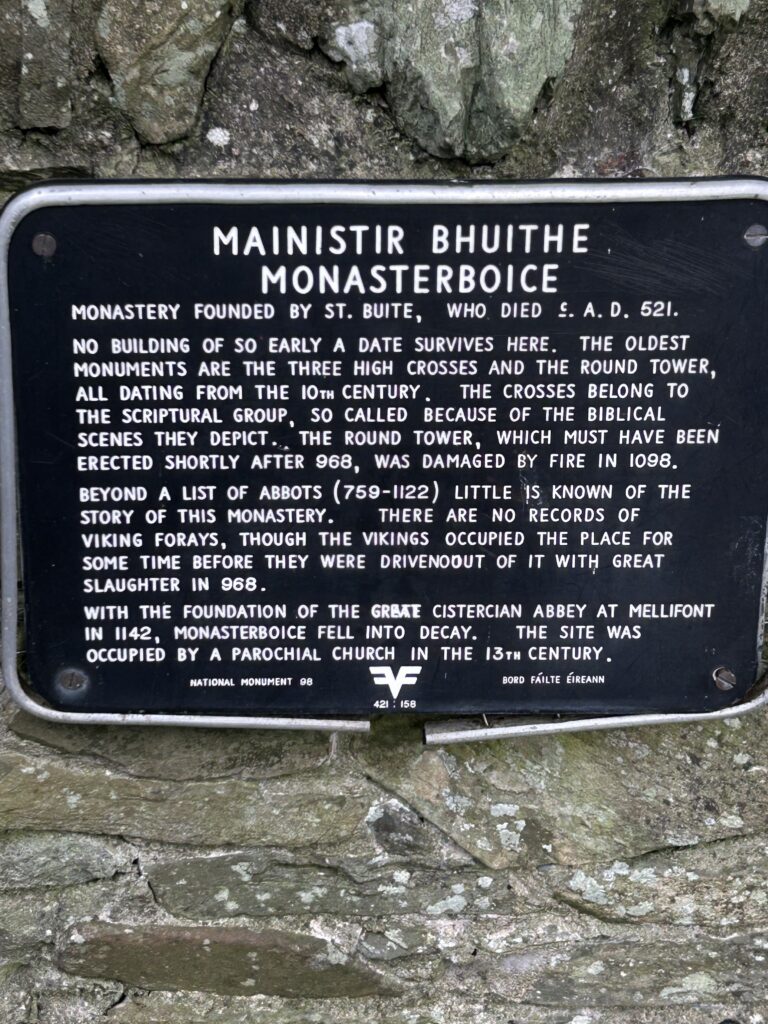
The site was first settled by the Irish saint St. Boetius around the 6th century. Highlights of this historic site include a nearly 100-foot round tower that dates back almost a thousand years and three 10th-century high crosses.
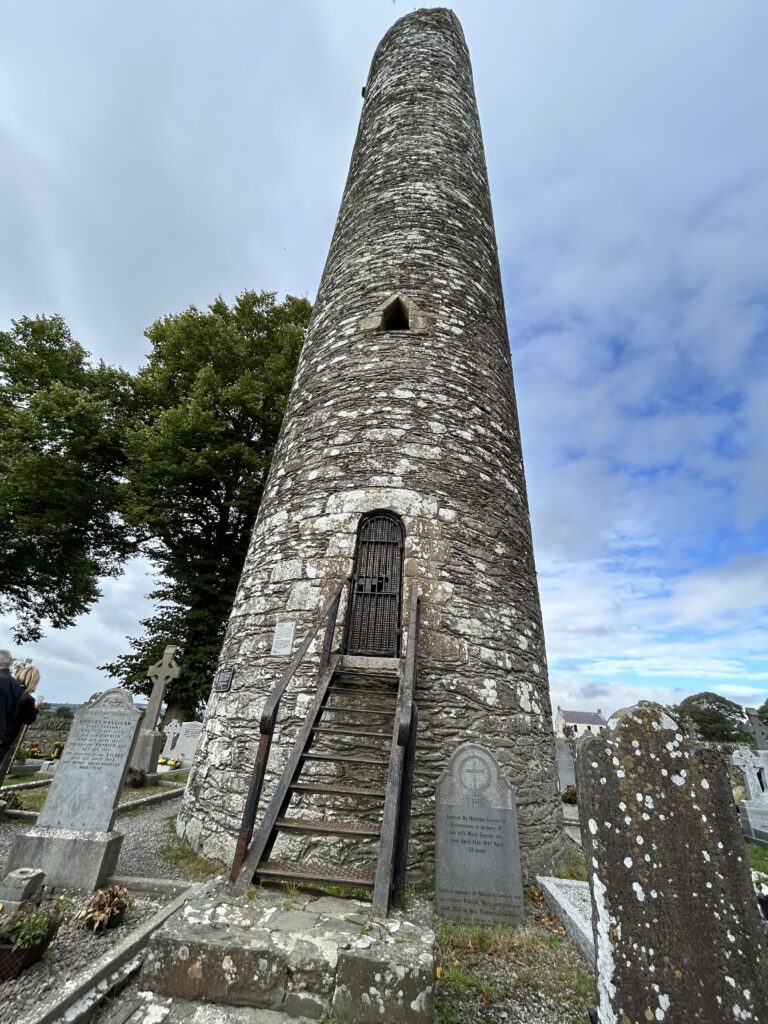
Monasterboice Round Tower
This early Christian settlement features several unique structures from ancient times. The round tower, nearly 95 feet tall (and likely taller originally), is impressive for a 10th-century creation. It primarily served as a bell tower to call monks to prayer, but our guide explained it was also used to store valuables. The door is elevated, requiring a ladder for entry—an effective way to remove the ladder and make access more difficult.
A fire in 1097 destroyed some of the tower’s wooden structure along with the monastery’s books and treasures. Today, you can still marvel at its size and imagine the importance of the site a thousand years ago.
Surrounding the tower are three of the most iconic high crosses of Ireland: Muiredach’s Cross, the Tall Cross (West Cross), and the North Cross.
Monasterboice High Crosses
This site is home to some of the best Celtic crosses in Ireland. The most impressive is Muiredach’s cross, an intricately carved cross standing over 16 feet tall. Because most people could not read, the carvings were designed to tell Biblical stories. The base bears an inscription honoring Muiredach, an abbot of Monasterboice who died in 924.
- East side: Depicts Bible stories and the Last Judgment, including St. Michael weighing souls while the devil snatches the wicked with a trident.
- West side: Shows the crucifixion of Jesus. On the base, Christ is mocked by soldiers. Amid these solemn scenes, you’ll find playful details—two men pulling each other’s beards and, for cat lovers, two cats (one a kitten, the other about to eat a bird).
The Tall Cross (West Cross), just shy of 23 feet, is the tallest high cross in Ireland. Made of four stone sections, its east face features Old Testament scenes, while the west side depicts Christ’s crucifixion.
The North Cross, set off to the side, is much simpler and was heavily refurbished in the 19th century.
Monasterboice History
First settled over 1,500 years ago, most of the relics you’ll see date to the 10th century. In addition to the graveyard, round tower, and Celtic crosses, you’ll find a sundial and ruins of two churches.
The abbey was established in the 5th century by Saint Buithe, a follower of Saint Patrick, and quickly became a center for spiritual and educational life. Two church ruins remain—the South Church (or “Great Church”), destroyed by fire in 1097, and the North Church, built in the 13th or 14th century after the monastery’s decline.
For Viking enthusiasts, Monasterboice was also a target of raids. Vikings occupied the site in the mid-10th century due to its prominence.
Visiting Monasterboice Ireland
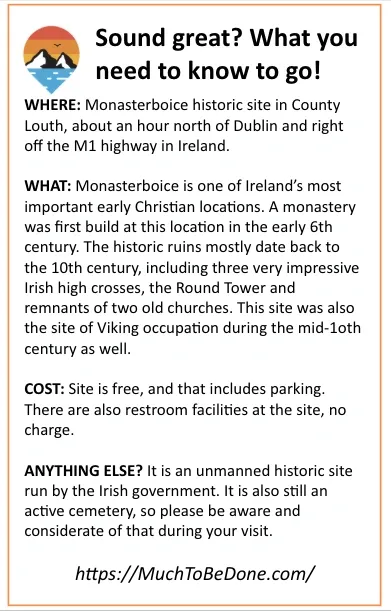
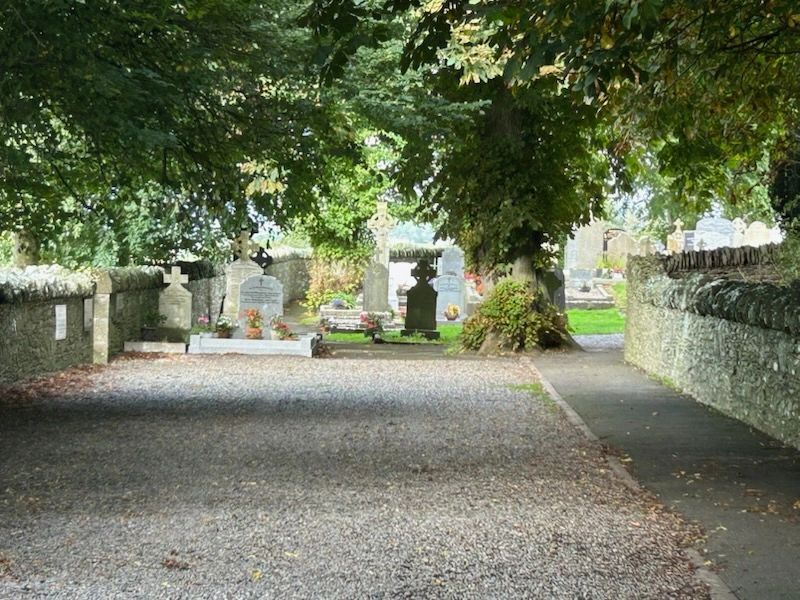
We spent about 45 minutes exploring. The high crosses alone make it worth a stop on your way north from Dublin. Monasterboice directions are pretty straightforward. It is in County Louth, just minutes off the M1. Managed by Ireland’s Office of Public Works, the site is well maintained, and admission and parking are free.
The official site notes wheelchair access on gravel paths, though some areas may be challenging. There are restrooms, but no official guides—we didn’t see any staff during our visit. Finally, this is still an active cemetery, so please be respectful.
If you’re exploring Europe, before to check out our travel tips for first time European travelers.